

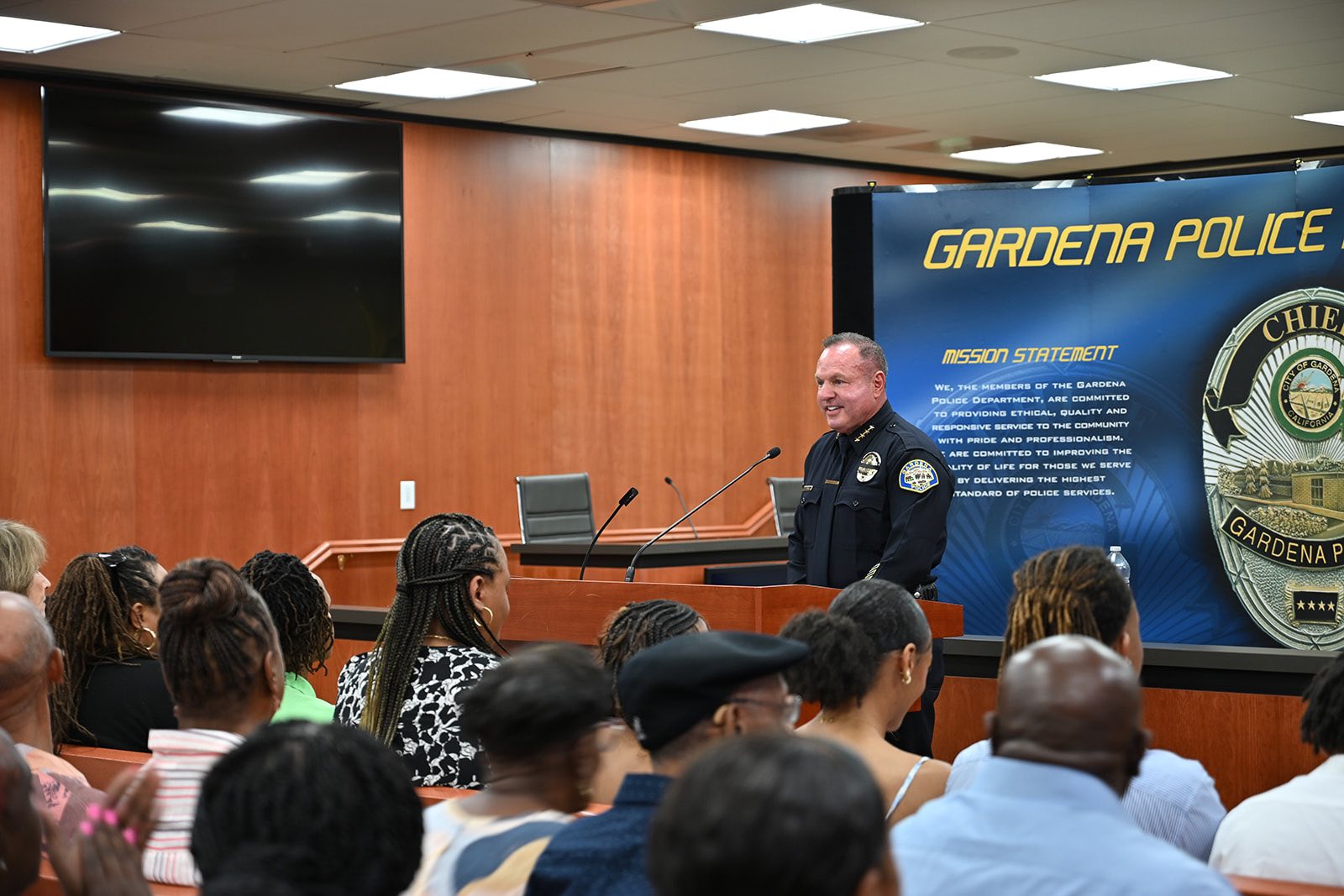
It was at the City Council meeting on May 27 that former Deputy Chief Todd Fox was promoted to Chief of the Gardena Police Department following the retirement of the popular Chief Mike Saffell. Chief Fox may have a different personality to Saffell, but the two men both care deeply about this city. The GVN spoke to Chief Fox about his career so far, and the challenges that he faces in his new position…
Could you give us a summary of your career in the police, up to joining the Gardena Police Department?
One thing I want to say is that it didn’t come easy. I’ve had to work hard for everything I’ve got. I actually got my start in law enforcement in the mid ‘90s, and I had worked in the aerospace industry prior to that. When I first started applying to be a police officer, it was very different. Back then, there were 350, 400 applicants for maybe one or two positions. Unlike today, where we’re offering signing bonuses and desperately seeking people that want to be police officers.
It was the complete opposite for me back then, and there was a lot of competition. I was competing against people that already had civilian positions at police departments, some sort of experience, and I just was not getting anywhere. I was landing on a list and never getting hired.
So eventually, in I think 1994 or ‘95, I put myself through the South Bay Police Reserve Academy at El Camino College, and that was a regular police academy, only just on the weekends and weekdays. And it was tough. So I completed that, graduated from the El Camino College Reserve Academy, and I then was able to get hired as a reserve officer for the city of Hawthorne. I worked there for a little while, and then eventually I got hired full time at El Camino Police Department, and as a fully sworn police officer. I worked there for a little over a year, and then I went over to the city of Gardena.
So when I came to Gardena, it was in 2001 and I was a little bit older than most people. I was already in my early 40s, and so I worked my work my way through patrol here, worked very, very hard to become a detective, and I did that for a number of years. I made a name for myself in the detective bureau, and eventually from there I put in for the position of police sergeant, which is a very competitive position to get here at Gardena Police Department. I competed for that position, and I was very fortunate to land number two on the list, and was eventually promoted to the rank of sergeant.
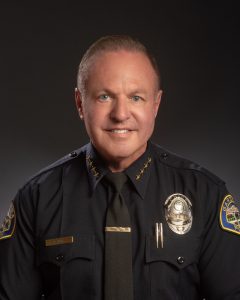
Again, I worked very, very hard being a patrol sergeant, and earned the reputation of the guy that’s able to get things done. And when the position opened up for lieutenant again, it was competition. I competed against another sergeant who had been here a little bit longer and had done a few more specialized details, but I was able to come out number one from the lieutenant list, and eventually got promoted to the rank of lieutenant, and my very first responsibility as lieutenant was to implement our body worn video program.
This was in 2014 in 2014, it was not very common for police department’s police officers to have body cameras and so we were one of the first police departments in the South Bay to implement body worn video cameras. And that worked out to be very successful. I remained a lieutenant for several years. And, you know, a small police department, it takes people to retire for the higher ranking positions to open.
Eventually there was an opening for a captain, and I put in for that. COVID had hit, so that postponed that, and then I was promoted to the rank of captain during COVID. That was a huge challenge. That was a responsibility that I took over, dealing with all the protocols. And making sure people wore masks and and all the things that came along with that, dealing with with county health and in all those things, keeping all the protocols current for our police officers and dealing with those that would get COVID.
I worked as a captain for about four years, and eventually the position for Deputy Chief opened up but that was kind of complicated. The other Captain retired, and we didn’t have any captains, so Chief Saffell said, ‘Hey, I’ll have you be the deputy chief, and you could help train the two new captains.’ So that was going to be my main mission as the deputy chief. And then eventually, Chief Saffell decided that he was going to retire, and with the experience that I had, I was very fortunate enough to be selected to succeed the chief.
But you know, the point that I wanted to make is that this: none of none of these positions came easy. I had to work very hard. I had to earn every, every single one of them. It wasn’t that I just fell into all these. It kind of seems like it, but it wasn’t. It was a challenge throughout my whole entire career.
Why was the body cam program, such an important cause for you to push through?
One of the things I was supposed to do while testing for lieutenant was to give a presentation on body cameras, and be whether I was pro or against it, because, like I said, it wasn’t very widely used, and during my investigation of it, I used a study that was done, and what they found was that it reduced the number of citizen complaints, or sustained citizen complaints, I should say, and it also reduced the number of uses of force that officers were using. And the idea was that everything is captured on body camera. It caused the officers at the time to utilize what we now have, de-escalation, to utilize more de-escalation techniques to prevent a use of force.
And it just helped, sometimes, for the community members, the contacts that the police officers had, if they knew that they were being videotaped. Sometimes their demeanor or their behavior would change. And so that was the idea, is that it reduced use of force, because when they knew either the the person stopped, or the officer knew that everything was being videotaped.
The other thing that it did was it reduced the number of sustained complaints where you could have a person who makes an allegation against the officer and before body camera, it was their word against the officer’s word. Sometimes that didn’t always favor the officer, because there was just no proof. So now, with body cam video, we’re able to either clear a complaint or we’re able to deal with a training issue if there’s something that they could have done better or differently with dealing with the public, absolutely. And then one other thing too, it also helped the DA s office with the DAs office filing against them.
You also said that competition for positions used to be immense, and now it’s a little different environment–what do you put that down to?
Back in the ‘90s and early 2000s, there were a lot more people that wanted to be police officers. There were less positions open, and now in the later 2000s, everywhere is hiring, and a lot of cities are offering signing bonuses. So I do attribute it to the sign of the times that not everybody wants to be a police officer anymore. It’s a very difficult job. I would say that there are hundreds and thousands of great police officers out there in this country doing a great job every single day. However, the bad apples that get talked about, those are the ones that get highlighted, and it does not make this job very appealing. So it’s easy for someone to go, ‘Hey, I would much rather work in a corporate setting than go work at a police department.’
So it’s much more difficult to fill those positions, and their other problem is, there’s a big gap. So you had a lot of people that were police officers and then a lot of retirements, and not enough people to backfill for those retirements.
On the other end of the scale from those couple of bad apples you’re talking about is your predecessor, who was incredibly popular. What did you learn from Chief Saffell?
You know, it’s hard to itemize what I learned from him. I worked side by side with him for pretty much the whole time he was the chief. Every Chief of Police has a kind of a different personality that they want for the police department. Chief Saffell was very much engaged in the community, as is everyone here at the Gardena Police Department. We have a district policing program, which is neighborhood watch. I would say that in the South Bay cities, Gardena enjoys a great relationship with the community. They know us and they trust us, and so we definitely have that going. And that began back in 2007 when we started the district policing program. I was part of that in the very beginning as well, and we’re continuing that on.
But everybody’s personality is unique, and Mike Saffell’s personality was unique in that he made himself available, 24/7, to the community members and he always showed up at every single event, whether it involved the police department or not. So he really was at the ground floor with the district policing and getting to know people. I think that that was helpful for him and why he was very popular with the community.
I’m a little different. Community is very important to me, and I too am attending events and stuff like that. We have these community events, and they get to know us, and it’s nice, but I also hear community members wanting to know what we’re doing to combat the catalytic converter thieves or the car thieves or the burglars, or the crimes that are occurring in the city. So I am getting us focused on what the initial thing is for law enforcement, and that is to fight crime and be visible to our community members. They want to see the police cars up and down their streets in the residential areas, and I intend on making that happen. I would say that our officers are eager to to get out there and to prevent crime, to keep the city of Gardena safe, have the community members feel safe, that we listen to them, and that we care about, whether it’s property crimes or quality of life, and of course, crimes against persons.
What would you say are the biggest challenges? Obviously, Gardena is a great city, and this is a scary time and a weird time in many ways, with federal agents and in state. So what are the biggest challenges you’re facing?
Well, I would say that the most complaints that we get are traffic related, speeders, intersection takeovers, those kinds of things, and we have a plan for that. Our traffic bureau is putting together a program to where we are going to get information, gain intelligence on some of these cars that are taking over intersections, and the law allows us to write warrants and seize those cars, and I believe that that will slow down some of these intersection takeovers that affects everybody in the community. It ruins the roadway. It’s dangerous for them. It’s dangerous for people in the community, and it’s a nuisance.
Is there anything else that you’d like to add…
The other thing that we plan on doing is just continuing to be transparent with our community, through our neighborhood watch meetings, through our social media. We have a great social media team, and we’re getting our message out there, and we’re getting a lot of positive feedback, and I think that, again, it just is being transparent and open with our community.